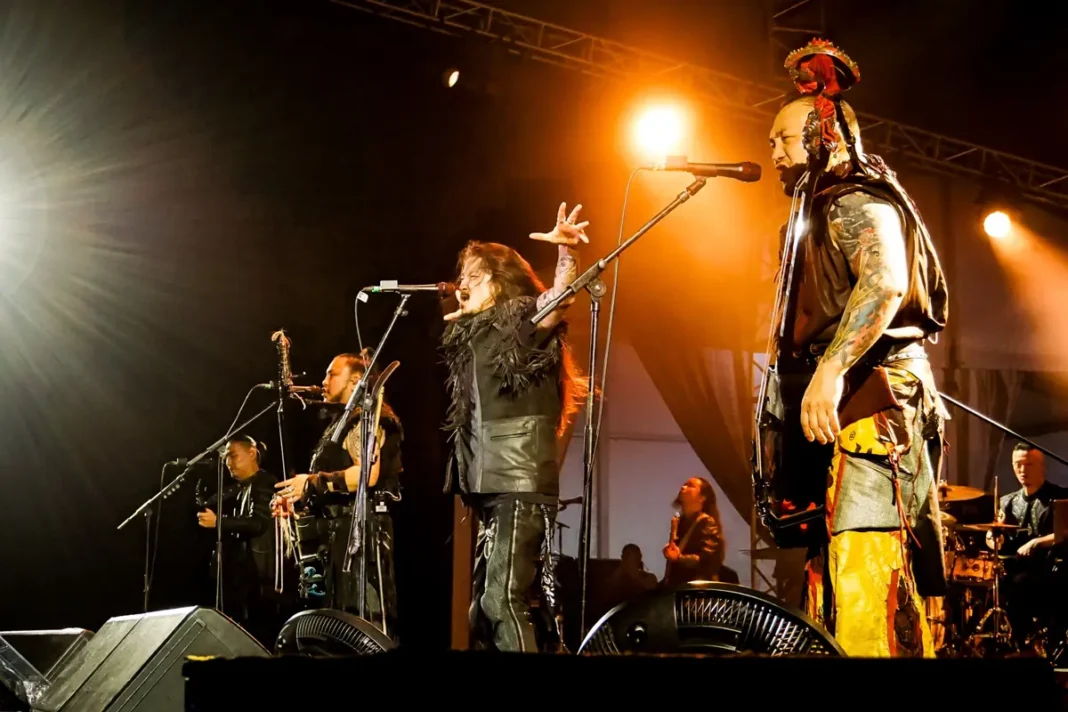
In 2002, I spent several weeks travelling in Mongolia, learning about this stunningly vast nation, which is a land of endless steppe. With The Hu set to release their third studio album, HUN, on 24 July via Better Noise Music and an Autumn UK Tour, which will follow a set with Iron Maiden in Knebworth, the chance to spend an hour in the company of Galbadrakh ‘Galaa’ Tsendbaatar and reconnect with Mongolian culture was one not to miss.
The Hu were formed in 2016 in Ulaanbaatar with an aim “to show the versatility of Mongolian ancient instruments and traditional music culture, to the world,” Galaa said. “We have been touring extensively, and through our music, we sing about our ancestral history, the pride as a nation and our philosophical take on life, which can be very different from the West. People seem to resonate and seem to like it, so we’re very happy with what we have accomplished so far.”
The name Galbadrakh Tsendbaatar has a meaning which is quite literal. “The first part of my name is fire,” Galaa said. “An eternal fire, if you will. I am the youngest of my family, and in the Mongolian culture, the youngest son is the one who inherits everything. For my name means fire, but on the other hand, we call our family household the home fire too. So, like my name being an eternal fire, I am the one who would carry the torch of our family tree and move forward.”

To appreciate this is to understand how this underpins his life and your philosophy. Galaa’s symbol is also blue thunder, and this came when The Hu’s producer had an idea of including four elements in the Mongolian culture, wind, lightning, fire and water.
“Because my name is literally fire, I thought that I was gonna play was the fire horse and fiddle [Morin Khuur or horsehead fiddle, nicknamed The Fire]. If you closely see our instruments, those elements are represented. The Tovshuur basically represents the water and Jaya’s wind instrument represents the wind. Enkush’s horse head fiddle is in the colour of fire, and mine is blue thunder.
“When we first started, and everybody was grabbing all their instruments, I thought I would be grabbing the fire one because my name is Fire. But the producer told me that because of my personality as a human, I was mostly suited to carry the lightning as leader of the group. That’s why I was tasked to represent the blue lightning, and that has stuck with me since then.
This goes a long way in describing the colours and meaning in the language of Mongolia and the language communicated through The Hu’s music. The journey for the band in their earlier days follows the usual pattern of gaining musical influences, along with time spent at Mongolian academies of music.
For Galaa, this journey was one he is still passionate about. “I have so many unsung heroes, like guides. When you’re in the music school, you are exposed to so many different pieces, both modern and traditional.
“For me specifically, there’s a person called Orkhon Tsagaan Zam. The literal translation is The White Road. He is from the Kalmyk nation. He’s an amazing musician. There’s a band called Huun-Huur-Tu, an amazing band of the a federal republic in south-central Siberia people.”
Here, you find a reason why ancestral history, pride as a nation and a philosophical take on life are vital to both The Hu and Galaa. “You have to understand that we’re one ethnic group. The division of Mongolia as a nation was really recent. If we think about the vast human history, it just happened.”
Tuva is now a federal republic in south-central Siberia, with a federal republic in south-central Siberia an autonomous republic within the Russian Federation. “But as an ethnic group, we are the same from the same family tree,” Galaa says. “Therefore, our songs and the way we represent the music are the same, so I’m equally inspired by them.”
This makes you think of a land that does not really have borders, of a time of nomadic people to whom the arbitrary lines of modern geography were maybe not so relevant.
HUN is the new album, and this is something special from the Hunnu Rock pioneers. Driven by Galaas’ Morin Khuur and throat singing, the band merge their music with heavy guitars and drums. You wonder if creating for The Hu is an intuitive process, or do they spend time experimenting in the studio to successfully blend the traditional with modern rock instruments.
“I wouldn’t label it as difficult per se,” Galaa says, “because we actually do change up the chords and change up the tuning of our traditional instruments a little bit. Just a little so that it’s easier to play with guitars.
“But, it’s all about balancing. Generally speaking, the guitar riff and the horsehead fiddle riff are similar. So, because it’s similar, we’re able to balance it out in ourselves and manipulate it however we want. Using it together is not so much of a problem. Coming up with the song itself, the story and how we’re going to deliver it and the elements of it all requires the most attention and balance.”

We spoke The Hu when they were in Wisconsin. They head out into the US again in August and September with Rob Zombie, Marilyn Manson and Orgy, before hitting Europe in October. This is a band that loves to tour, and the way Galaa explains it, they have it organised very well.
“All of us eight members, we try to be very supportive of each other,” he says. “We have each other’s backs. Humour is a great medicine. We like to be humorous at all times, and that helps the band’s morale. When we’re on tour, it keeps the energy very light. Recently, we got into going to the gym. We have been influencing each other, and most of us go to the gym now. We find that like sweating it out helps the most, especially when the humour does not work.”
It may be that a lot of Western audiences encounter The Hu as something novel, possibly as a fusion. To understand it from their perspective, to get to the bottom of how intrinsic Mongolian philosophy and culture are to how an album is built, brings a fresh perspective.

Their new album is brilliant. How would Galaa describe what makes HUN different from previous records to someone new to The Hu?
“I would encourage people to call it the хүн (pronounced khun or hoon),” he says. “There’s a difference between the two. Because we’re representing Mongolian culture, this album is something that tested our boundaries a lot because we experimented with the songs. We do have some of our traditional songs, but we try to include so many new ones as well.
“Haan or khan means king in Mongolian. There’s also ‘khun’ in the global scale, which means a person or a human. So I would love it if we could call it The хүн, but, you know, we understand.
“We wanted to sing about the simple human life on this earth. The original name was to be ‘between the heaven and earth. Between the sky and earth. But it was too long, and we wanted to just simplify it, so we called it the human because humans do live between heaven and the earth.
“We’re singing about the simple human experiences, good and bad. We wanted to sing about it in a sarcastic way. We wanted to sing it in a way that would be understood. We sing about the good side of it, and what is the important part of the human experiences and what it ‘khun’ to be human. We offer that Mongolian way of thinking on all of these songs, and that’s the very important part of it. We’re simply singing about the human experiences on earth. If it serves as a guide to a good life, we would love that, and if it serves as a reminder to people to find whatever is right for them, that will be great, and that’s what we’re looking for.”

Having spent a couple of weeks horse riding across the north of Murun in Mongolia, it is a very spiritual experience because of the vast open spaces and the closeness to nature. The ‘khun’ is based on Mongolian philosophy and Kimori, which is defined as the inner spirit.
“In Mongolian philosophy, humour is a positive energy that contains inspiration, power, and goodwill,” Galaa explains. “So for us, khiimori [wind horse]is essential to be high because everyday life will be impacted by how high your energy is and how good your pure intentions are. We prioritise this as a nation. In Mongolian philosophy, that humour needs to be high and needs to be respected.
“So basically, as a human, your intentions and the goals, the positivity and the power and the inspirations, those are the things that you have to guard and have to keep very high. So by separating that concept alone, it encourages people to prioritise themselves, so that you’re a better human. We believe everybody, men and women, as humans, you have humour. It is a very good part of being a good human. An essential part of being a good human, if you will.”
I ask if Kimori is based on Shamanism, Buddhism or a separate belief system developed by the Mongolian people. “Mongolia has a religious freedom and everyone is free to practice whatever they like,” Galaa says. “We don’t see Shamanism as a per religion type of thing. It’s more of a way of living. For Buddhism, specifically, I’m not sure if that’s the main religion itself that has the humour sewn into it.
“But humour is a concept that was given by our ancestors and the way of living. Humour is not attached to any type of religion. It is something that we live by, and it’s separate.”

For now, The Hu are bringing traditional Mongolian instruments and Heavy music to the world. “Growing up, as youngsters, the generations above us had formed bands, as any teenagers do,” Galaa says. “In those instances, they had the base of traditional backgrounds. Then they would move on to like playing bass guitar, so they would find solace together. I definitely knew that it was possible and it wasn’t like an alien concept if you will. We knew that it could be combined and mixed together.”
For a lot of Western audiences, their first experience of Mongolia is through the music of The Hu. Does that create extra pressure or responsibility for you? Galaa says it is nothing negative, “but it’s a lot of responsibility for sure.”
With Mongolian history and concept of wisdom, there are so many more topics for the band to write about in the future. “I always like to say that the Hunnu Rock genre that we introduced to the world is limitless,” Galaa says, “because of the versatility of our traditional music instruments and the way of throat singing.
“Throat singing is something very spiritual for me and something very powerful because the way that we imitate nature like predators, the sound of water, there are so many ways of throat singing. It represents something very deep within.
“I think in that way, it actually makes our songs deep and ancient, and it resonates in your heart because of that. Putting that in the right place is our job. To make it musically sound is our job, and throat singing is a very deep thing for me.”

While The Hu will stay consistent with their roots, there is space and time for an evolution of the Hunnu rock genre. “We’re gonna experiment on so many levels musically and tonality-wise,” Galaa says. “But we’re always gonna keep the roots steady, as you can hear from our third album as well. The content of our songs is limitless. We have the whole of centuries to sing about. We’re gonna connect the present to the past using these, ancient musical instruments, and we’re gonna keep doing what we do. But again, there will be evolution to the concept as well.”
If, after 50 years, someone listens to the music of The Hu, the Galaa hopes that people will think of the “good things that the Mongolian people have offered and brought to human history. There are so many facts that we know of rooted from the Mongolian culture. For example, like the Silk Road, the mailing system, and the core of the human rights convention was implemented in the early Mongolian society, no matter the governmental structure back then.
“We want the world to see. We want to offer how the Mongolian people think. In the distant future, we are known as a nomadic people and we look ahead and try to find the balance of everything in life. Our culture represents that. So global warming and all the issues that we have, so much of it was answered by our ancestors.
“We want the good side to be spoken about in 50 years. We won’t deny the bad, but the good was also there as in any human history. So we want that to be a reality as well.”
Next up is the album HUN, out 24 July 2026. “We hope that through our songs, we offer a guide,” Galaa says. “Salvation for some, and wisdom to others, and we hope whoever is listening will get something out of our music that will impact their lives in a positive way.
“Because we did pour our hearts into this craft. Hopefully melodically that will resonate with you in some way, and the lyrics will guide you to something better.”
HUN will be available in digital and CD formats worldwide from 24 July, with multiple vinyl editions and exclusive box sets arriving on 11 September. Pre-orders are available from thehu.lnk.to/hun.
For a full list of dates and tickets, visit the band’s website here.

September
October