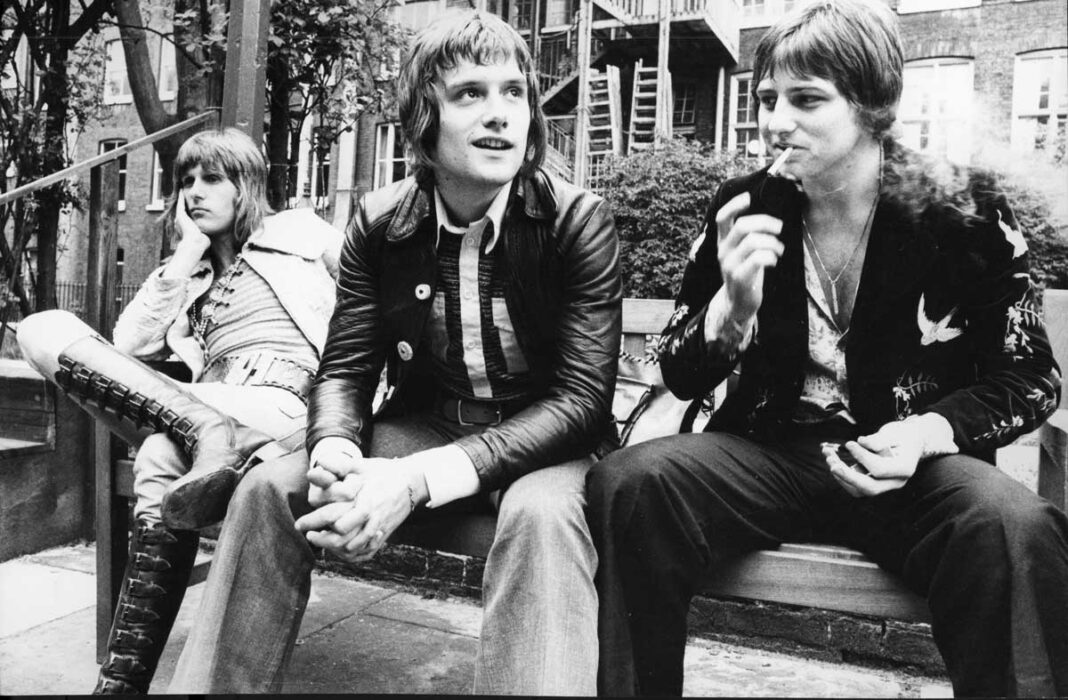
Emerson, Lake & Palmer never did things by half. The legendary trio seemingly delighted in pushing boundaries since first forming in London during the heady days of 1970, with a vision to bring their music to the biggest audiences possible and to capture the grandeur of their material in a way no one had tried before.
With their gift of balancing the cerebral with the visceral, their music and shows blended elements of rock, classical, jazz and even some shades of pop, the whole an irresistible combination that saw them quickly rise to play stadiums.
With a string of acclaimed albums under their belts, the outfit became household names, offering something different in a time where fizzy commercial bands, glam rockers, crooners and soul superstars dominated the charts. To own a copy of Tarkus, Pictures At An Exhibition, Works or Brain Salad Surgery, the latter featuring a cover by famed ‘Alien’ designer H.R. Giger, was seen to some as a sign of sophistication but also something that transcended generations and all strata of society.
The critics were not always kind. But that is not who truly mattered to the trio. Emerson, Lake & Palmer made music for themselves and for everybody.
Leaving a huge hole when they went their separate ways in 1979, each embarked on their own projects, with drummer Carl Palmer becoming a founding member of supergroup Asia. The next few years saw each happily creating music, but the call of the trio working together again was too hard to resist, and they reunited in 1990, going on to make new music together and touring the world.
Old tensions between keyboard player Keith Emerson and guitarist eventually came to a head, and the band separated again in 1998, returning for a one-off farewell show to thank the fans at 2010’s High Voltage festival in London’s Victoria Park.
With the passing of both Emerson and Lake in 2016 drawing a veil over the band, it was down to Carl Palmer to keep the music alive and his distinctive drumming style continues to be seen all over the world, latterly driving his outfit ELP Legacy.
With technology progressing, the world has now reached a stage where things could be achieved that were never even considered before, and this has led to the birth of a thrilling and groundbreaking new project.
With the groundwork laid on tour in America, next year sees three special shows where Palmer brings Emerson, Lake & Palmer back to the stage, with the drummer, his ELP Legacy bandmates, and his two old friends coming together like never before.
A hugely ambitious project and one that’s taken many months of work, MetalTalk sat down with the legendary drummer to hear all about An Evening With Emerson, Lake and Palmer.
The excitement around this project is built on the quality of the source material. “I physically play nine tunes with Greg and Keith,” Carl Palmer said. “They’re in situ on the screen in perfect time with me as if we were all there together.”

The Emerson, Lake & Palmer shows at the Royal Albert Hall in the early ’90s were recorded with a five-camera shoot, but the audio was recorded separately. “This meant that I could actually take away the drums,” Carl Palmer said. “I could then look at the five-camera shoot, and I could edit myself out of the videos, put Keith and Greg on each screen, and I could play my drums live in that particular theatre. The keyboards, the voice, the guitars, the bass guitar, the drums, everything can be mixed for the acoustics of each hall.
“So this is the only show that exists right now out in the world. It’s not a hologram, it’s actually Keith and Greg at their very best. That’s obviously coupled with Paul Bielatowicz on lead guitar, Simon Fitzpatrick on the Chapman stick. But it’s all integrated, it’s all one big show.”
The evening will have three screens, roughly 14 ft by 8 ft deep, and will show Carl, Keith, and Greg playing together as if they were there. There will also be vintage footage on the centre screen.
The film was originally released as a DVD by Sanctuary, later sold to Universal. “It probably sold between 10,000 and 12,000 copies,” Carl says, “so it wasn’t that familiar, which is good for me now. We were very upset at the time, but it’s working wonders for me now.”
It took Carl Palmer “8 to 11 weeks to do all the editing to get me out of all of the footage that shows Keith and Greg. I don’t need to be in it because I’m on stage, and we can project me onto the centre screen. Obviously, I had to find some outtakes and things that would help me out and make it all work properly.
“We’ve then used an AI program to get rid of some of the graininess, some of the smoke, and some of the red lights. It’s not quite IMAX level, but it’s up in that area.”
The fact that all the original, different audio parts, as well as all the footage from each camera, were available is what has made a project of this scope and ambition possible. “Normally this can’t be done, and it just seemed the most honest way to do it,” Carl says.
“Holograms look a bit fake and phoney. This is real. This is Keith Emerson at his very best. It’s Greg Lake at his very best.”
The first three weeks, Carl Palmer says, were difficult, but with remote help from “somebody upstate New York,” the remote editing was completed. The original DVD was approved by Emerson, Lake & Palmer, and these shows have the full approval of the families of Keith Emerson and Greg Lake.
“It’s been one of the best things I could ever do for Keith and Greg,” Carl says. “They would rather have this than a hologram. I did go to hologram shows. I went to the Frank Zappa show at the London Palladium. I saw the Ronnie James Dio hologram. It’s not real, and there’s no need to do that anymore.
“If you’ve got the flexibility that I had by having the audio tracks recorded separately, then it’s just down to hard work doing the editing and getting it to look right. That was what I wanted to do, and I’ve managed to do it. We’ve been touring it for about three years in America. We’ve obviously added to the show since we started. We play 14 pieces altogether, so quite a comprehensive show.”
There is a live version recently released of Peter Gunn, from the Montreal Olympic Stadium, when Emerson, Lake & Palmer played there, which has been used as a trailer for the new Brad Pitt film. “At one time they were just going to use it for the trailer,” Carl says, “but they decided they wanted to use it for the film.” The Adventures of Cliff Booth will be out later this year.
Carl Palmer will have a click track and a separate monitor feed, as well as a separate TV screen, “to get it all absolutely linked up. This is only available because of the technology and the fact we had the right material to work with in the first place. This is way in front of what anyone else is doing.”
Carl says it has taken time for people to get the concept. “They grabbed it in America after about 15 months. Who knows how it will work here? There’s been a lot of sarcasm on social media. Is this a money grab? Well, it was approved by the families, it was approved by the group as a DVD, so as far as I’m concerned, I’m just exploring what we already had.
“I’m bringing back the opportunity to see Keith and Greg for those people who didn’t see the three of us playing together. So I feel very positive about it. We have had some negative writings. Social media’s what it is.”
The care and attention that has gone into this, you feel, is driven by the passion Carl Palmer has for this music. Back with two old friends on stage, it should feel wonderful. “I don’t know how I could have done anything any better than what we’ve got,” Carl Palmer says, “because we’re just so fortunate. Just the other day, we found a piece of footage from Germany for Tiger In The Spotlight. We had an actual tiger in the studio.
“I had to lay the tracks again to get it into proper stereo, ‘cos it wasn’t from the Royal Albert Hall. But it was such a monumental piece. The shock value was intense, seeing the band playing with a tiger tied up in front of the stage.
“It took about 10 days, and we relayed the tracks. We made sure all the keyboards were stereo. We got different mixes on them. We added a Leslie in there, triggered by Keith’s own organ, so it’s all him. We did use a little help from an AI program to get that because I’m right in the middle of it all. We had to wipe me out and put the tiger in another position, and that was it.
“So it’s something which is ongoing, and I can definitely carry on doing it. My next ambition will be to take pictures at an exhibition by Mazorgsky from Montreux Jazz Festival, and I think I can integrate Greg and Keith into my band with Paul and Simon playing.
“We can play various sections, and then we can trigger the footage for Keith and Greg to be playing with me or Greg singing on his own, or a keyboard intro by Keith. We’ve got it down now, it’s an art form, and I’ll be able to take this further.”
There is a very human side. There is a connection with people in the music, and there always has been. Emerson, Lake & Palmer pushed things bigger and better than anyone. The ambition they had as a band from the very start has been something that so many people have followed in their footsteps.
“It worked against us for a long time,” Carl Palmer says, “because they called it saber rattling. When we spent all that money on the shows and things, why do you have to have a flying piano? Why do you have to have a revolving drum set? Well, those things are absolutely nothing today compared to people like U2, the Rolling Stones. Whatever we could do to add some excitement to the music, that’s all we were interested in.
“The music was always the first thing. But if you could supply some eye candy, then yes, we were ready to do it. We were always that way. I have an amazing piece of footage of Fanfare For The Common Man, which I play in the show.
“It’s Keith Emerson riding his L100 across the stage, stabbing daggers into the keyboard. These are monumental moments. These are just moments that had to be captured, and I’ve got them, and we’re using them. It’s got a lot of positivity about it all.”
Carl Palmer says the band put what money they made touring back into future shows. “In those days, selling records was more important, and you didn’t need to make money from concerts. That’s why people started calling us pretentious because we were setting down another blueprint.
“Not only were we the creators of that art rock form called progressive rock, but we also were starting off developing stage shows. So we got attacked from all corners, really. But we thought it was the best way. The ELP catalogue is unbelievably strong. I’m amazed by the ticket sales that I’ve got with these three concerts. It’s just phenomenal. People have wanted to see this, and it’s being received right now, very positively. So I’m very, very happy.”
I suggest that a lot of music these days is transient. The chart music is here today, gone tomorrow, very disposable. But Emerson, Lake & Palmer built a legacy, and this music lasts.
“Good music does last,” Carl Palmer says. “If you’ve got a great song, it should sound just as good on an acoustic guitar as well as a 60-piece orchestra. If it’s a good song, it’s a good song. I think the advantage we had, whilst we were labelled prog rock and we were one of the beginners, as it were, as a band of that movement, was really short-changing us.
“We were quite eclectic. We played classical adaptations. We did have epic pieces like Tarkas, which were prog pieces, self-penned, which we wrote ourselves. We did have things like Pirates, another 20-minute piece. But on top of all of that, we had folk pieces by Bartok, like Barbarian on the first album, Knife Edge, which is a rock song that we wrote, Paper Blood.
“Then we had all these beautiful ballads, 3-4 chord ballads. Still You Turn Me On from the beginning. Lucky man, I Believe in Father Christmas, which I’m sure you hear every year. Really, this is not a prog band. This is a band that just plays great music and always has. It just takes time for people to come around to actually see that.
“Bands like Dream Theater, they’re a prog band. I would consider them to be a prog band, not ELP. We were called a prog band because we used the latest technology, the Mini Moog and the Moog console at the time, and we had a couple of involved pieces. But then you turn the corner, and we had a piece called Lucky Man that’s got three chords to it, a simple folk song. We were eclectic.”
Lazy pigeonholing, maybe, but they were the first to be called a supergroup. “That wasn’t something that we chose,” Carl says. “We just got labelled that, at the very beginning. I was a big fan of The Nice, Keith’s previous group. By the time we had got together as three people, the climate musically had changed, and they started calling people super musicians. Then they became a supergroup.
“It’s not a label that we put on ourselves, just like prog rock was really not a label that we put on. Just like people said, oh yeah, Jimi Hendrix was going to join them, and it was going to be called Help. That’s all just journalistic sort of garble.”

The first successful single Carl Palmer was on was aged 18 with The Crazy World Of Arthur Brown. “We had a single called I Am The God Of Hell Fire, which was number 1,” Carl says. “I went to America first of all with Arthur when I was 18.
“Then followed with the Atomic Rooster, and I had an album out on B&C. Robert Stigwood was the manager. Then I was approached by Greg and Keith at that stage, but I had started recording the second album with Atomic Rooster. I recorded a track called Tomorrow Night, which ended up being number one for Atomic Rooster.
“I’d already gone over to Greg and Keith, and they [Atomic Rooster] had to re-record it with another drummer. I do remember sitting in rehearsals hearing the radio, and Atomic Rooster were number one with Tomorrow Night, and I’m with Greg and Keith, and I’m thinking, I wonder if I’ve made a mistake here.
“Obviously, I didn’t. But I’ve been very lucky. ELP has had a number one in this country with a Fanfare. We had a number 1 in Canada with C’est La Vie. I think Lucky Man was a top 5 in America. I’ve been blessed, really.
“I’ve been in a few groups. There’s not many drummers that have had three number 1s in their life with different bands. Of course, there was Asia with Heat Of The Moment, which was huge in America. So, I’ve had four really in a row, I suppose.”
The chemistry between Carl, Keith and Greg was fairly immediate when they first played. “We were strictly into music,” Carl Palmer says. “We talked a lot about record collections. When I first sat down with Keith and spoke to him about his record collection, we went through what jazz records he had. It was basically a carbon copy of what I had on the shelf.
“When I spoke to Greg about pop music, commercial music, what he had with Simon and Garfunkel and the Beatles was the same again. So there was a lot of internal synergy there of what we liked and what we wanted to create.
“We hit it off. Sometimes it just happens, and you don’t know why. It’s probably to do with the past, having similar likes and dislikes. It worked. It worked from day one.
“I was always a Keith Emerson fan anyway. I used to go to the Marquee on a Monday night and watch The Nice. I was always a huge fan because of the classical adaptations that he was doing. I really wanted to be in a band that did that because I come from quite a classical background, my grandfather being a professor of music at the Royal Academy.
“We played a lot of classical music in my house. I went to Gilbert Webster at the Guildhall. I went to James Blaze at the Royal Academy. So I had quite a good training in classical, but it didn’t really appeal to me because there’s not enough for a drummer or percussionist, really. You do spend a lot of time counting bars.
“But The Nice were playing classical adaptations, and I got attracted to modern contemporary instruments playing classical music. That was a big thing for me.
“I eventually met Keith when I was 17, at Goldsmith’s College in London. I had been called up by John McVie, who’s the bass player in Fleetwood Mac, who said could I play because Mick Fleetwood was ill. This was the Peter Green, Jeremy Spencer Fleetwood Mac. The very, very early band. I ended up playing with Fleetwood Mac that night, and top of the bill was The Nice. That’s when I first got to say hi to Keith. So I’ve known him since I was 17.”
History reports that sometimes things between Greg and Keith could be a little fractious, but, somehow, out of that, they produced some extraordinary albums. “You never want to be in a band where somebody sits on the fence and agrees to everything,” Carl says. “You want to be in a band where someone’s got a very strong point of view.
“Both of them had a very strong point of view, as I did. I might have acted more as a referee, which was fine because they were more talented than me as far as the writing was concerned.
“But at the end of the day, that’s the kind of band you want. You don’t want somebody who just agrees with everything. You want somebody who puts stuff forward. You want somebody who rebels as long as it’s with a certain amount of logic and understanding of the situation. That’s what you need. That’s what makes a great group. And if they’re good musicians as well, you’ve got something special.”
The last show Emerson, Lake and Palmer played in the UK was High Voltage “Yes, it was 2010,” Carl Palmer says. “That was the very last one. We did it to say thank you to the English public. Thank you for giving us a chance, giving us a start. We just wanted to sign off, and we did.
“Keith and Greg died in 2015. Keith was in March, Greg was in December. Then, in 2016, John Wetton died. So I lost three really important people in my career in that period.
Keeping spoilers to a minimum, there will be footage of The Simpsons talking about Keith Emerson in the new shows. “The amount of vintage footage I’ve got is just phenomenal,” Carl says, “and people will be completely immersed in it.
“This is not a rock show. This is a complete immersion of music, of a visual, of effects. For me, it’s the way the business is probably gonna go over the years.”
Carl Palmer says it has taken three years to get back into England with this show. “I’ve got lots of videos to promote it and how it’s done, what it’s done, people’s reaction. I decided only to do three because I figured, if we get three in a row, we’ll knock that out. If people want more, then we’ll come back the following year.”
Now, with these three shows, there is the chance to bring something special, something that both families have approved. “I know Greg and Keith would have approved,” Carl says. “So to me it’s just a joy turning around now and seeing them on the screen. No tension, no sadness, just complete enjoyment.”
Tickets for An Evening with Emerson, Lake & Palmer are on sale via ELPTickets.com.