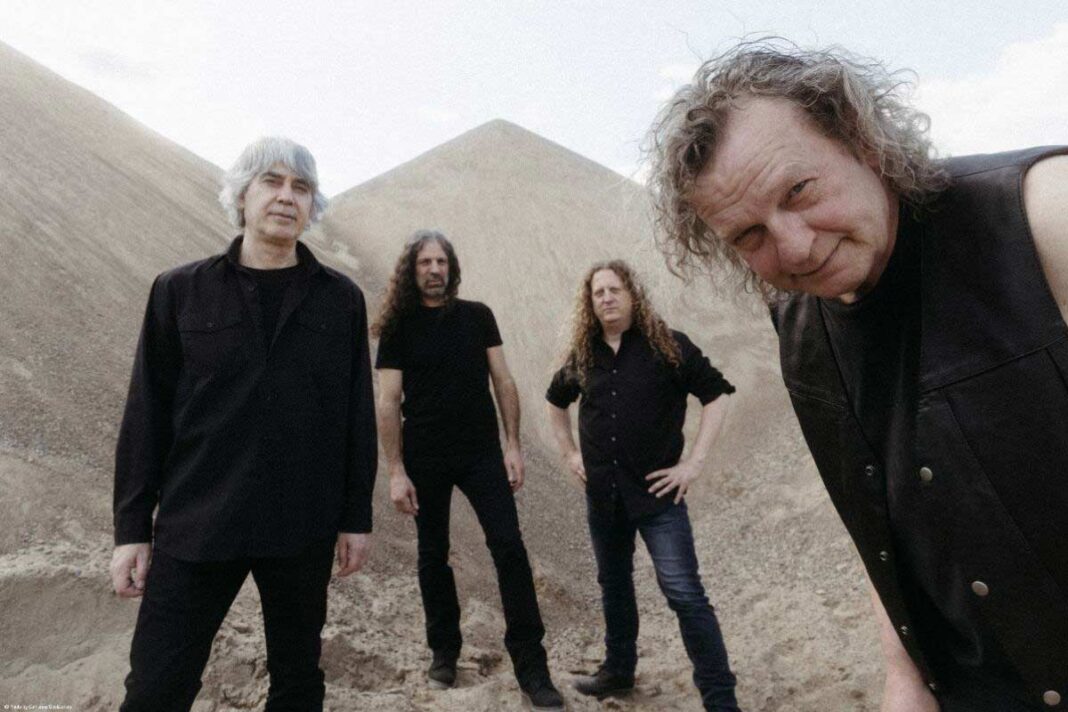
2:30 pm in Montreal, and Michel ‘Away’ Langevin greets me from his home. We are here to chat about Symphonique, the stunning new album by Canadian legends VoïVod. A collaboration with the Quebec Symphony Orchestra, and recorded in June 2025, it is incredible. Few bands are so suited to crafting a dystopian cinematic soundtrack, but then there are few bands like VoïVod.
VoïVod were formed in 1983, with 16 studio albums under their belt, the collaboration with an orchestra follows in the footsteps of a hundred Metal bands, but few make it sound so incredible. But before we get into the album, I have to clarify a question that has bothered me for years. Do the band call each other by their nicknames or their first names?
“We call each other by our nicknames,” laughs Away, confirming that even when Jason Newsted was in the band, they called him Jasonick!

Having lived with Symphonique for a few weeks ahead of the interview, I am in awe of the quality and complexity of the release. Away explains how it came together. “The Montreal Symphony Orchestra reached out three or four years ago. It took a couple of years to put together, but we knew some of the songs could be adapted to an orchestra”.
He refers to the Nothingface period (1989). “We were really influenced by modern composers like Shostakovich, Penderecki, Bartok, Stravinsky. So, we put a lot of that into our music. We knew that certain songs from Nothingface in particular would fit with an orchestra.
“There were other songs that were really influenced by the early cyberpunk movies like Mad Max, Blade Runner, and Terminator. Forgotten In Space was really influenced by Mad Max 2, Road Warrior. And the song has many movements, so we figured it could be a good choice.
“We tried to stay away from real Thrashy material, although we picked Nuclear War from the first album because we thought it could become a very scary military march with an orchestra. It came out really good.
“Of course, we wanted to try the Sid Barrett song Astronomy Domine with an orchestra. It was really fantastic. Some songs actually surprised me. I kind of knew that because of the drama and the songs like Into My Hyper Cube or Fall, I knew that it could become very interesting with an orchestra.
“But the song Fall in particular became even more dramatic. During all three performances in Montreal and Quebec, after that song, we had a standing ovation.
“But all of this took a couple of years to put together with the arranger, Hugo Bejan. We were very involved with him, supplied the charts and a lot of ideas. I was mainly involved with the graphics animated behind the stage, so a lot of work on my end regarding that. Now we have the show down, we’re actually going to do it again early next year in our hometown, where we formed in 1983, with the local orchestra. So that should be quite an event.”
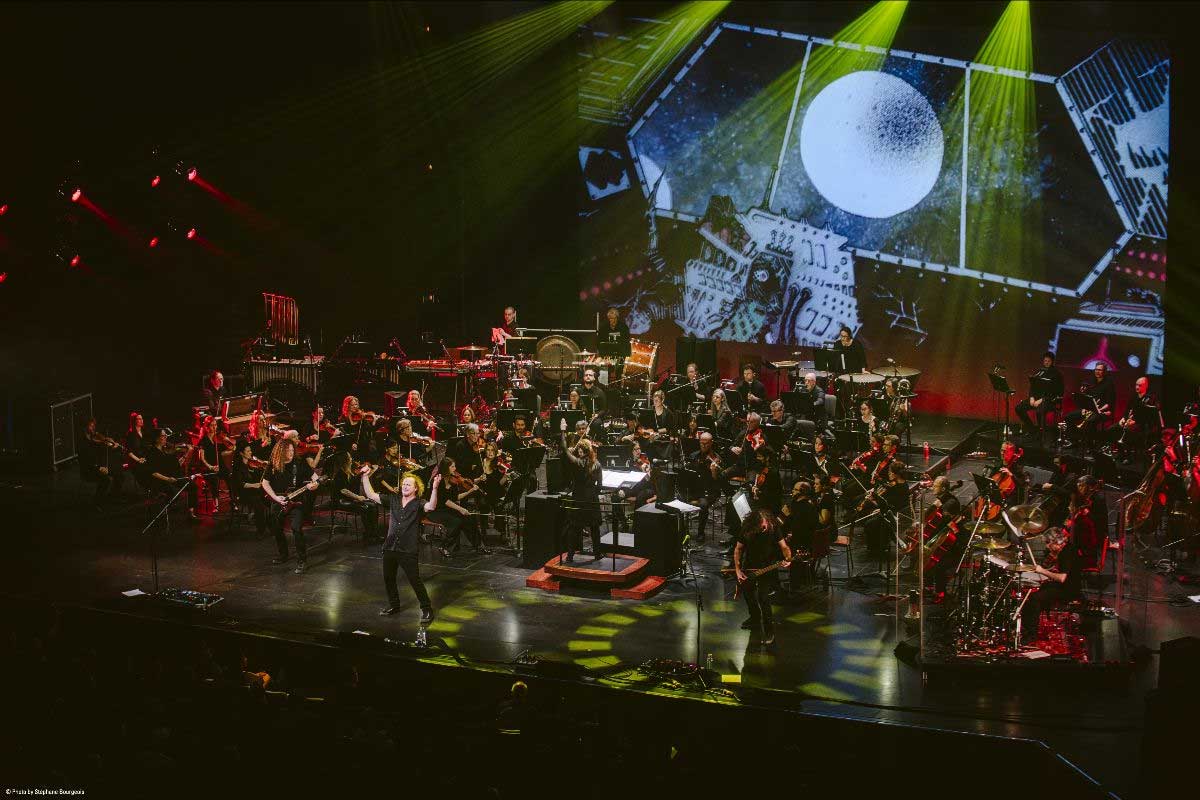
Drumming for a band like VoïVod is intense anyway, but throw in working with a conductor with a symphony orchestra, and it is a different ballgame altogether. There was a lot of pressure resting on Away’s shoulders. How much adaptation did he have to make to fit the orchestral arrangements?
“Well, the difficulty was that we were coming off a tour where we were slowly including Symphonique songs into the set list until we finally did the performances with the orchestras. But these were new arrangements where I had to stop there and there, where I’m not supposed to. I really had to be focused.
“I worked a lot with Dina Gilbert, the conductor. She has very frank movements, and I was following her a lot. We had quite a few cues where she’d turn around, because there are many breaks in our music. We worked a lot with her, and she’ll be with us for the next show. Hopefully, she’ll be with us everywhere because otherwise we’d have to start from scratch.
“As a drummer, I really had to be super tight with the conductor. I even had to change my style of playing just a bit because, aside from punk and Metal, I learned to play a lot with proggy material like Magma, Van der Graaf, Soft Machine. So, there are a lot of ghost notes on the snare that I had to try to get rid of and to be more precise.
“Aside from that, it’s the same energy. These shows were a highlight in my career, but definitely the biggest challenge because of what you were saying earlier. If I missed a beat, the whole orchestra gets lost.
“The first show, I was really, really focused. I didn’t have time to look at the screen behind the public or the orchestra. I was very focused on being tight with the conductor. Second show was more relaxed. Show three, I could really enjoy it.
“The one we documented in Quebec City, I was really at ease, and I was able to really enjoy the whole environment and watch the musicians and the animations behind and make eye contact with the public. I would say the main difficulty for me was technical because we all had in-ears with a belt pack. We couldn’t really have monitors. I was also playing in a glass cage on the side of the stage, so I had to adapt to that environment a little bit.
“Hopefully, we can take this show on the road with local orchestras. What they must do is, like what the Quebec Symphony Orchestra did, rent the charts from the Montreal Symphony Orchestra. So that’s the way to do it with a local orchestra.”
Being to the side of the stage to accommodate the orchestra rather than being centrally placed did slightly impact initially, with Away telling me that he felt a bit far from the action. It was only on the first show that the real challenge came to light.
“I didn’t realise when we were sound-checking for the first rehearsals that the projections were reflecting on the glass cage I was in. And so, once we started the first show, it was hard for me to see Chewy because I had the animations right in front of me, reflecting on the plastic.
“I didn’t realise that before all the lights were down, so it’s something I had to fix the next day. After that, it went well. But again, I think that Chewy was exaggerating his movements for me because we were so far away.
“Usually, I’m right there with the guys. I usually don’t like to have a super high riser for the drum. I like to be there. It’s so technical and proggy that we need to be very focused together. Even though it took me a while to get used to the in-ear situation with the iPad, with the LEDs and everything, it was wonderful to hear every single member of the orchestra. So that helped a lot. It made me feel like I was in the action with the other guys at least.”
Away tells me that VoïVod is a band that has always embraced the change in technology and developments in new equipment. “The whole thing was moving together with the art. I was switching to digital, trying to explore new technology. We’re doing the same in the studio.
“The big discovery was in Berlin, when time came to record Dimension Hatröss with Harris Johns, the producer at Music Lab in Berlin, who had done Killing Technology. The second time we went there, he had a bigger studio, and he had bought a sampler, also a Roland Octopad. I really enjoyed swimming around with this new gear.
“When we did Nothingface, everything was digital. It was brand new. So, back then, it was stressful in the sense that we always tried to be experimental. Piggy was a tape manipulator, and then he didn’t seem to have a problem with the engineer cutting the tape to do some reverse effects.
“I was sweating, man. I had just spent hours recording the perfect tracks, and suddenly we decided to have like this reverse thing going. Then the razor blade comes out, and oh my God.
“When Pro Tools showed up, it was like, wow. So as much as we still try to, I’m reluctant to play over loops, but I like to have this real sound here and there, hitting on a pad. So we’re not necessarily techno using sequences and all that. It’s still organic, no click track. I mean, we try to have a click track in the studio but not live.
“In the studio, it gets crazy because there are many accelerations and decelerations. We programmed the whole thing, and I just play along, and it’s quite amazing.”
Michel ‘Away’ Langevin has supplied a lot of art to many different artists. “They use different techniques to animate my characters,” he says. “So, some use 2D traditional animation, some use the 3D CGI, some use AI. I always dreamed of seeing my characters animated, but I just didn’t have time to do much of it.
“I did some with Commodore and Amiga in the ’80s, and I did some in the mid-’90s with Silicon Graphics and 3D animation. But I’ve always been so busy being a rock ‘n’ roll drummer on the road, in the studio, that I’m happy when animator people are animating my drawings with different mediums.
“Some of the artists were feeding AI with my art, and it was my characters moving. So, I didn’t mind that at all. I use it occasionally because I studied science. I didn’t study art at all at university. I don’t have the notions. Quite often, I will ask AI to give me an example of perspective.
“Let’s say you want to draw somebody running towards you. It’s hard for me. And so, I quite often ask for an example. But I learned to be satisfied very quickly because of the environmental problem that we all know now, how much water it takes to cool down the data centres and all that. So, I’m trying to do my best. I try to be very careful.”
I wondered if any of the band had ever objected to Away’s designs for album covers, given that he is responsible for all their artwork. Thankfully, this has never happened, and he also explores the generation of the striking artwork for Symphonique. “No, I was never told this is not your best drawing. I know that everybody is really pleased with the Symphonique album.”
Away tells me he used digital tools where you can test different colours. “I supplied the examples to the other guys. There was one that had more of a cold approach, dark and almost black metal. Then I had this other one that was more like golden sunny. And that’s the one.
“Chewy really liked it. He said the shows were luminous, and I didn’t see them as dark, even though they have a dystopian feel. I went for the bright colours, which will probably stick out a lot at the record shop.
“It’s always been a goal of mine, ever since I saw the first Iron Maiden album cover when I was a teenager. I keep that in mind, because when I first came into the record store, that’s the first thing I saw. I grabbed it immediately before all my friends did.
“So, when I did the War And Pain cover for the first album, maybe before, that’s what I had in mind as well. It was sort of my homage to the first Iron Maiden cover, really.”

I tell Away that is exactly what happened when I bought War And Pain back in 1984. It was the album art that caught my eye. You clearly got it right back then, I tell him.
“That’s perfect,” he says. “It’s what I also had in mind when I bought the first Iron Maiden album. One will buy Judas Priest’s British Steel, the other one will buy Ace Of Spades, and then I will buy Iron Maiden, and then we’ll go home.
“We had to hitchhike 500 kilometres to Montreal to buy our vinyl. But when I saw that cover, and I turned the cover around, and I looked at the band, I thought, this is my new favourite band. When I went home, and I put the needle on, it was exactly what I wanted to hear. It was Prowler.
“That’s what I had in mind when I did War And Pain. It had to represent the music perfectly. I felt I was the only one who could do that, being in the band.”
VoïVod will be heading back on tour in Europe by the time you read this. They start with their first visit to Iceland at Satan Fest before Holland and then a series of shows across the UK with Midnight in support. With a full month of festivals to come in July and August, Away explains that the key to maintaining some sense of normality on the road is to get as much sleep as possible.
“Of course, the drums keep me in shape. I try to eat properly. I don’t party anymore on the road. It’s been a while. 25 years ago, I saw Tommy Aldridge with Whitesnake, and he was doing 90 minutes of double kick drums. I thought, if I want to be that guy, I better take care of myself.”
Away is a big fan of the rental bikes available in most cities as well. “I have a series of exercises that I do daily. I can still do it. The only thing I did over the years is I changed the size of my drumsticks. Three times, from Chord drumsticks to now, normal sticks for my wrist to make sure nothing happens. It’s good, we can still rock, I can tell you.”
VoïVod famously supported Rush on the Canadian leg of the Presto tour in 1990. I can’t miss the opportunity to find out what Away thinks of the Rush 50 Something tour. He’s excited. “Hopefully we’ll be in town when they come to Montreal. I’m not sure yet. I think it might be in September, maybe. But hopefully I will be around. I’m really happy for them”.
Away explains that as the sole member of VoïVod from the start, he’s well placed to give his opinion on the critics who say it is not Rush. “It’s not obvious when people tell you it’s not the same since this and that. But people leave, some people unfortunately pass, and some people find another line of work.
“But for me, I dedicated my life to VoïVod for 43 years now, and it paid off in the end. A couple of times, my friends were telling me I was crazy to go on because Metal had a bit of a lower profile. But now everything’s fine.
“We pack clubs, and we’re very well established. We play great festivals, and so we’re enjoying what’s going on. We can live off our music, and so we are having a great time.”
VoïVod release Symphonique on 5 June 2026 via Century Media Records. Pre-orders are available from voivodband.lnk.to/Symphonique-Live.
Canadian sci-fi Metal innovators VOIVOD have announced a fresh batch of 2026 tour dates, spanning North America and an extensive Summer run across Europe and the UK.
June