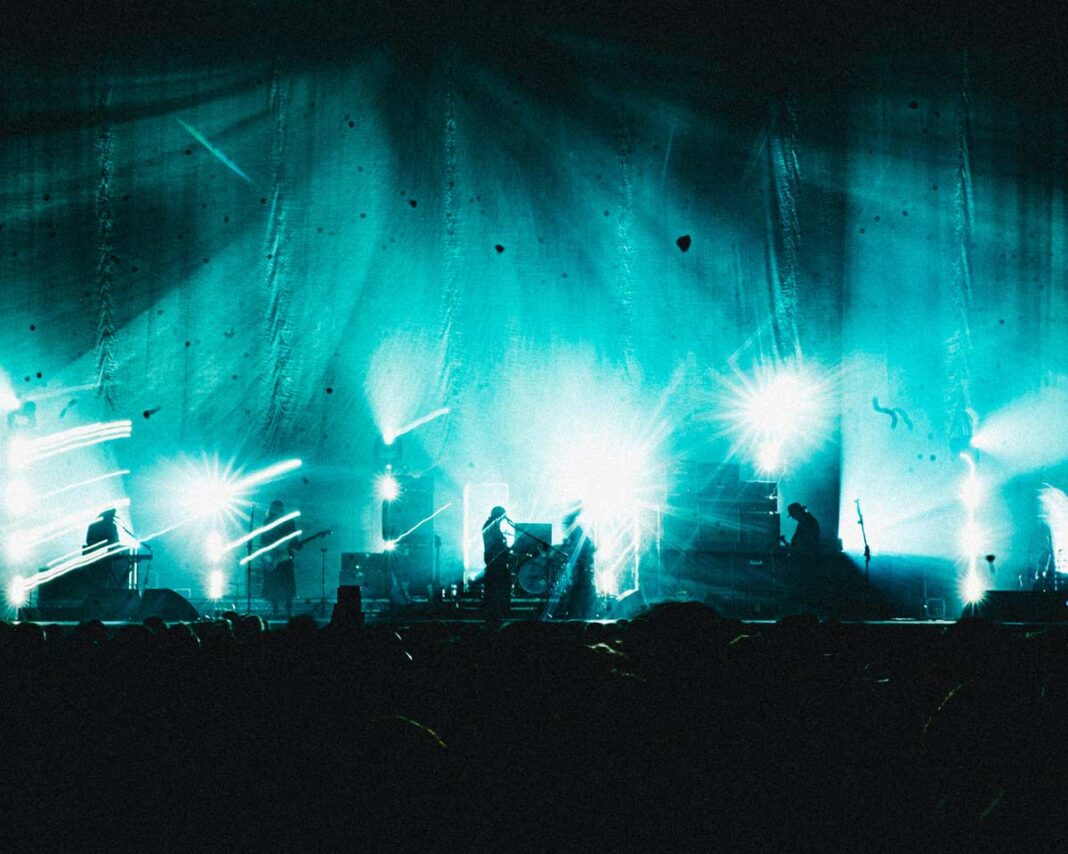
To be a fan of My Bloody Valentine has always involved a certain devotional masochism. Decades spent waiting for records rumoured to languish in the theoretical realms of Kevin Shields’ hard drives. Waiting for tours that appear with the rarity of a blue moon, and on this particular Tuesday at London’s OVO Arena Wembley, waiting for the inevitable post-gig ear ringing to subside enough to hear our own thoughts. Still, the appetite for this punishment remains ravenous.
My Bloody Valentine
OVO Arena Wembley – 25 November 2025
Words: Rhiannon Ellis
Photography: Isaac Watson
Walking into the cavernous maw of the OVO Arena Wembley, a venue with an event listing so incoherent it feels like an algorithmic hallucination, there was a wry absurdity in seeing the lodestars of intimate, dreamy shoegaze occupy such corporate brutalism. But looking at the crowd, the sense of pilgrimage was unmistakable.
As greying Loveless lifers clutched earplugs like rosaries alongside Zoomers buzzing with the giddy thrill of finally hearing their favourite reverb-drenched TikTok audios rendered at aircraft-hangar volume, the generational divide collapsed. They were all here to bear witness, united by the desire to worship at the altar of the glide guitar.
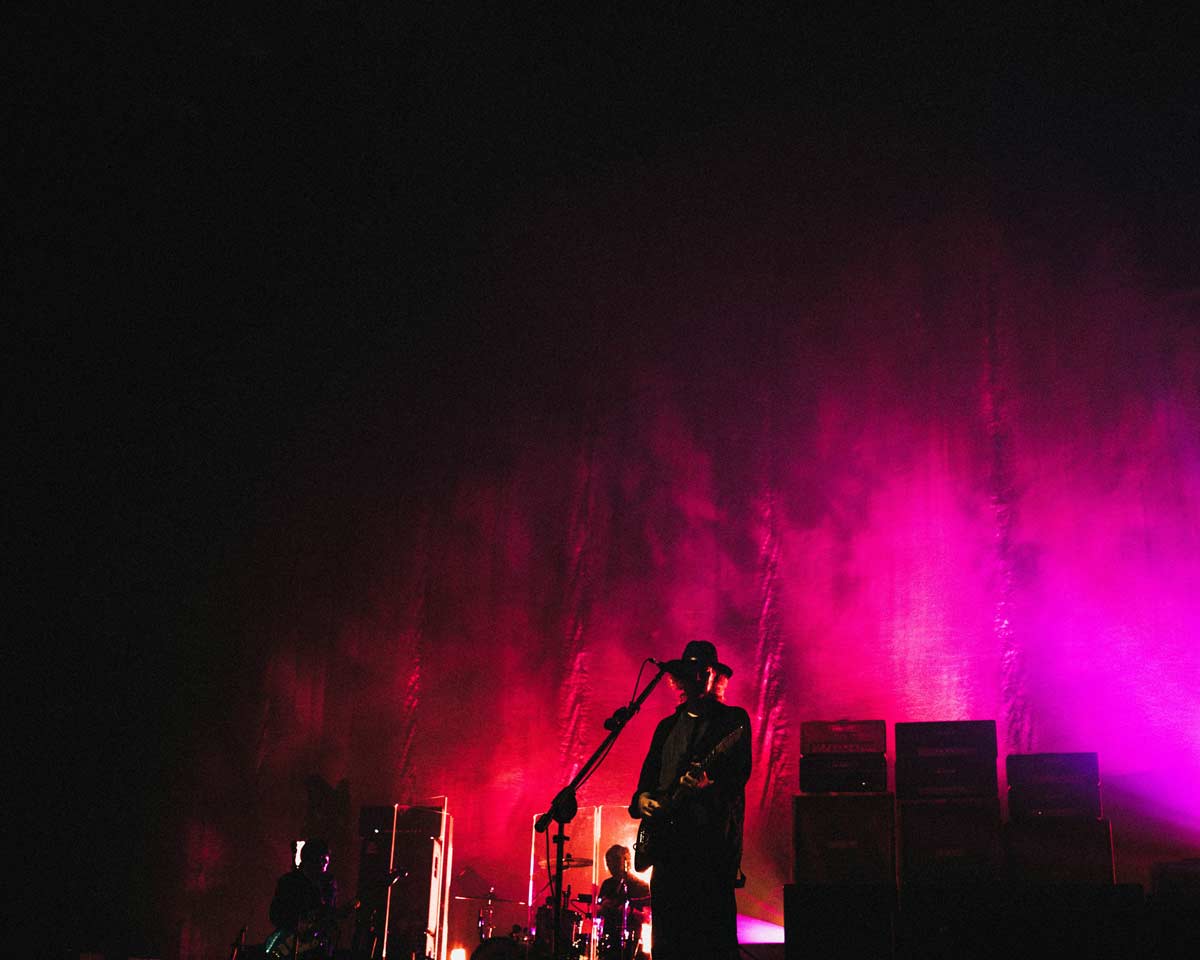
When the house lights finally drop, the Arena does not so much erupt as it does dissolve into a sumptuous fuchsia haze. The first notes of I Only Said bloom in a shimmering swell that seems to rearrange air molecules, sucking the air out of lungs in involuntary, awe-stricken sighs.
The My Bloody Valentine sound is instantly, shockingly beautiful. Shields’ glide-guitar tremolo unfurls like a cumulus on a summer evening, perfectly synchronised with the murmuration of starlings wheeling behind the band. Bilinda Butcher’s vocal drifts through the mix like gossamer caught on an updraft, breezy, weightless, almost illusory. For a moment, the concrete surroundings are forgotten, replaced by something tender, windblown, and impossibly wild.
Culturally, MBV occupies a strange space. One of the bands that killed the ’80s and invented the texture of the ’90s, only to vanish into the ether of Shields’ perfectionism. Tuesday served as a reminder of why their fans are happy to wait. My Bloody Valentine’s sets are not just heard, they are a somatic event.
In an arena setting, Shields’ notorious glide guitar technique, combined with signature manipulation of the tremolo arm, creates a queasy, pitch-bending warp that repressurises the cavernous room. The mix was thick, gelatinous, and ecstatically overwhelming.
At times, the vocals of Shields and Butcher were so submerged in the slurry of feedback that they became texture. A ghostly suggestion of melody haunted the machinery.
When You Sleep, delivered with effortless radiance, makes its influence on entire generations of bands feel suddenly obvious. It is phenomenal, shimmering, and entirely transportive. Behind the band, cityscapes drift and dissolve, skyscrapers bending like reflections in oil.
The band is washed in violet and magenta hues, casting them as silhouettes within an urban dream sequence. They remain intentionally obscured for much of the evening, silhouettes cutting against a lighting rig.
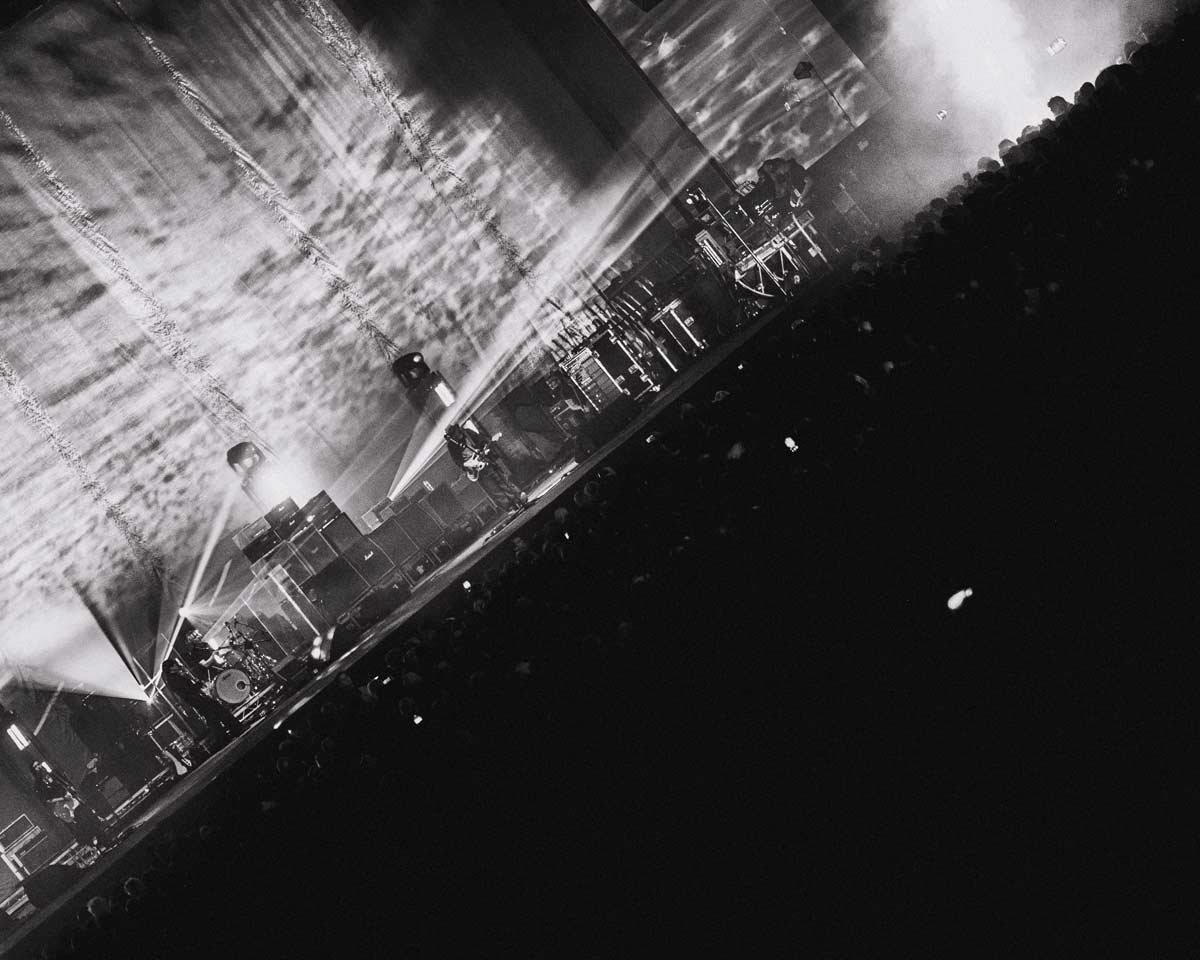
Dominating the visual field is a massive screen behind the imposing backline, projecting a live feed from the sound desk that superimposes a retromania fever dream over the musicians: saturated loops of burning film, blurred faces, and abstract colour fields creating a feedback loop of sight and sound, enveloping the audience in a technicolour womb that renders the vast, corporate architecture of Wembley surprisingly intimate.
As the My Bloody Valentine set progresses, the show swells rather than escalates. New You, a buoyant standout from 2013’s m b v, offers a moment of pure light, with Butcher and touring multi-instrumentalist Jen Marco interlocking in bright, crystalline harmony. It is an unexpectedly luminous, almost pop moment.
It would not be a My Bloody Valentine show without the threat of technical catastrophe. After all, Shields is a man who seemingly sold his soul for the perfect tone but forgot to negotiate for working cables.
There is a palpable friction onstage during these stoppages, particularly between Shields and drummer Colm Ó Cíosóig. As guitar techs scramble to diagnose a signal path failure, Ó Cíosóig fills the silence with restless, rolling drum fills-repetitions that seem performed with a mischievous glint, intentionally designed to grate on Shields’ nerves.
It is a fascinating, voyeuristic glimpse into the band’s dynamic; titans of the genre reduced to bickering siblings in a garage. After one particularly stubborn pause, Shields leans into the mic, offering a rare, dry explanation: “It’s an age thing, you know?”
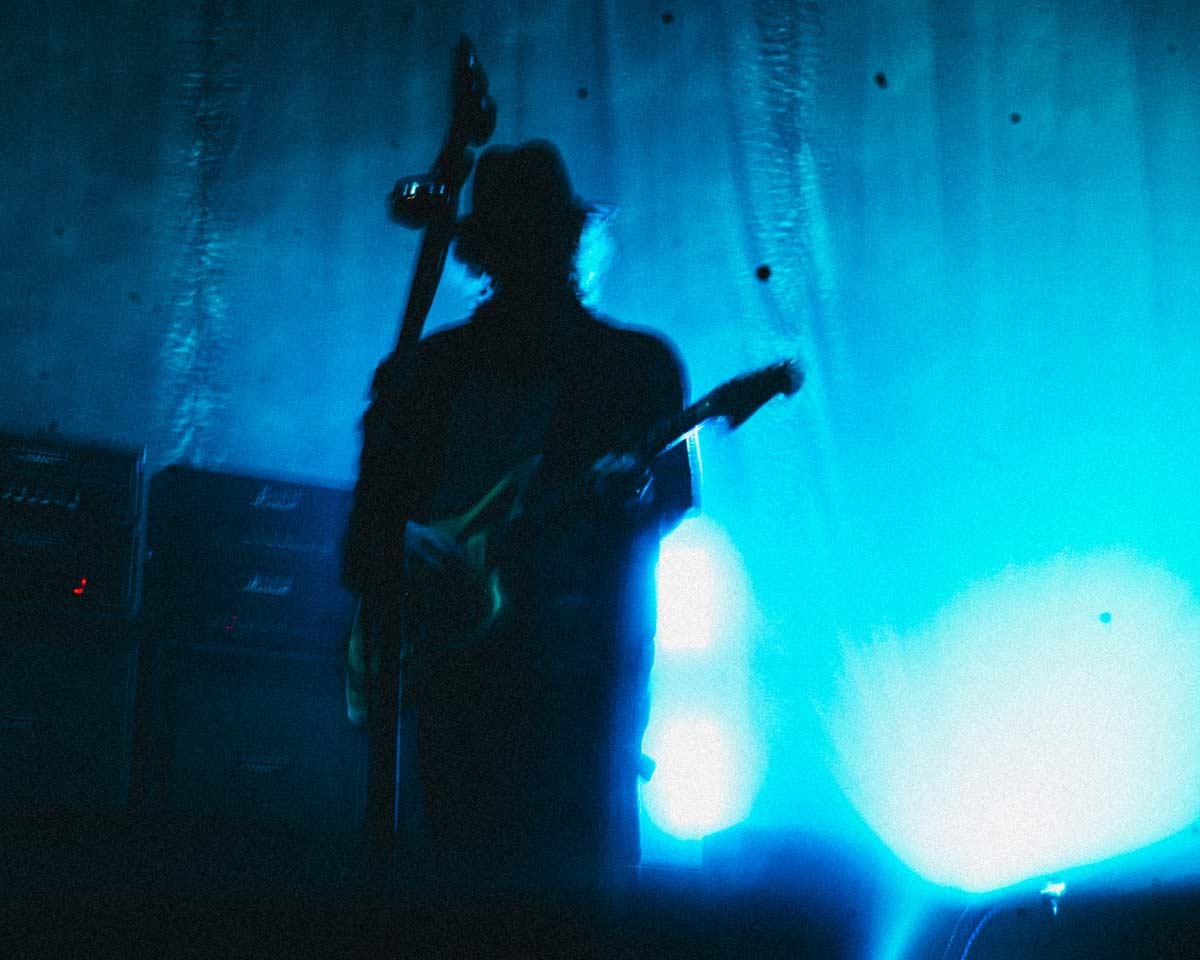
If anything, these brief glitches save the set from sterility. In an era where arena shows are often time-coded to the millisecond, seeing the architects of this sound struggle to wrangle it makes the performance feel aggressively live. The stuttering momentum oddly rebuilds the bridge between artist and audience, transforming a recital into a shared high-wire act.
When the machinery locks in, the results are devastating. Ó Cíosóig’s drumming is consistently fantastic, though initially mixed with a ferocity that threatens to capsize the melody-forward mix. Usually buried like treasures in the silt, the voices of Butcher and Shields swim up through the hazy guitars with welcome clarity.
As the set progresses, the sound coalesces into the “monolith” fans demand. The arrival of Soon triggers a near Pavlovian response in the crowd, the breakbeat rhythm cutting through the fuzz to ignite a trance-like, rave atmosphere.

But, everything leads to You Made Me Realise. The track begins with its driving, jagged verse before descending into the infamous interlude of pure, white noise. It stretches to a punishing, purifying ten minutes. It functions less as music and more as a sonic bath, a physical pressure that rattles the ribcage.
It is a moment of total sensory saturation. When the noise finally abates and the band waves their awkward goodbyes, the ringing in our ears feels less like damage and more like a souvenir, a reminder that for two hours, reality bent at its edges.
My Bloody Valentine remains distant, enigmatic, and impossibly exacting.
But that distance is the point: a space not to separate themselves from the audience, but to allow the audience to step inside the sound, to be held by it, engulfed by it.
At Wembley, engulfment felt like a strange, deafening grace.

J Mascis
Opening for a band that trades in weaponised volume is usually a daunting task, but if anyone has the necessary credentials, it’s J Mascis. His presence here feels less like a warm-up and more like the continuation of a long-standing dialogue between two of shoegaze’s loudest architects. This is a pairing rooted in deep mutual respect, defined by a shared sonic lineage – and obsession with the malleable limits of the Jazzmaster tremolo arm.
There is, however, a glorious incongruity to seeing the Dinosaur Jr. frontman – a figure of such iconic slacker repute – standing solo on an arena stage in 2025. He ambles unhurriedly into the spotlight, appearing for all the world like someone’s eccentric uncle who took a wrong turn looking for the smoking area and inadvertently stumbled out to face Wembley.
The set itself is not exactly a triumph of showmanship; it’s unvarnished, occasionally shambolic, and possesses the distinct air of a local pub open-mic night where a regular has been allowed five minutes to test out new material.
Yet, as he opens with Thumb, the sheer lack of pretence is achingly endearing. His voice, a cracked, idiosyncratic croon, earns more than a few perplexed glances, but the bewilderment softens the room rather than fracturing it.
As ever, Mascis’ true storytelling lives in the guitar lines he unspools with lackadaisical, almost negligent virtuosity. He approaches a guitar solo with the same absent-minded efficiency one might employ when making toast. Still, the results are undeniable.
Mascis delivers a set that’s unvarnished, naturalistic, and oddly comforting, somehow commanding a room by simply ignoring it. Surrounded by a modest semi-circle of pedals, he worked through a set that leaned heavily on Dinosaur Jr. classics stripped of their fuzz. Ocean In The Way and Little Fury Things were rendered fragile, folk-like, revealing the melancholy melodicism that often gets buried under the sludge.
His weary croaking sounded particularly poignant in the vastness of Wembley. At times, the performance blossoms into flashes of startling beauty. It serves as a perfect sonic aperitif: gravelly, sweet, aggressively human, offering a stark counterpoint to the alien monolith to come. The effect is quietly disarming.
Not You Again sparks the evening’s first moment of communal ignition. A rendition so warm that a shout of “Play it again” hangs in the air. The request lands somewhere between a joke and a plea, and for a fraction of a second, it seems entirely possible he might oblige.
But it is the finale, Alone, that truly lands. It arrives like a slow implosion, Mascis summoning a solo that sounds like Jimmy Page tumbling down a flight of stairs, amp in tow, chaotic and careening, yet landing every note with impossible accuracy.
By the time he exits, the room has shifted: bemused, softened, and ready for the noise.