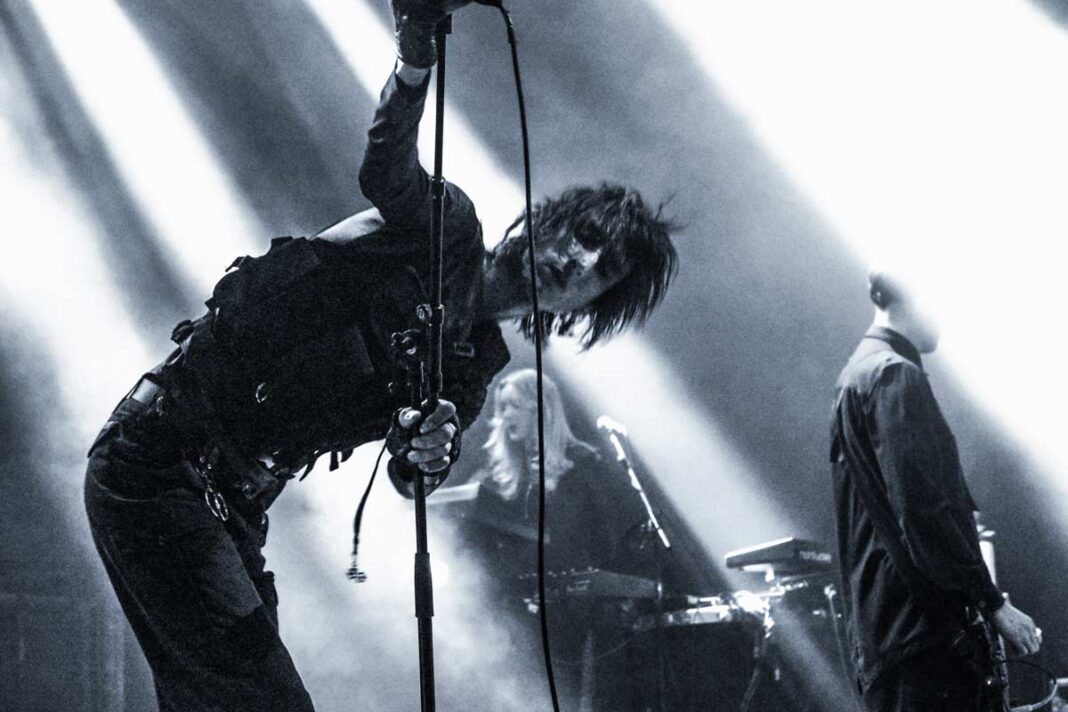
If there was any doubt that The Horrors remain Britain’s most fearless cult band, Saturday night at the O2 Forum Kentish Town shattered it. The Horrors brought their UK tour to a rousing, noirish close in a celebration of their sixth album and two decades of refusing to settle.
The Horrors – Bande À Part – Ominous Moon
O2 Forum Kentish Town – 29 November 2025
Words: Rhiannon Ellis
Photography: Ash Nash
Emerging from the indie-sleaze heyday, The Horrors have solidified their standing as the great, shapeshifting moths of the British underground scene. This is a band that retreats periodically into an amorphous chrysalis only to burst free, radically altered, but still retaining a cellular memory of every previous incarnation.

While the theatrical, hair-sprayed, garage-goth clatter of their youth still twitches like a phantom limb beneath sleek new wings, this gig was far from a nostalgia trip. It was a showcase set on underscoring their sonic arc, and the more mature, industrial machinations of their latest album, Night Life.
The Horrors emerged from the shadows, slipping straight into The Silence That Remains. The track’s heaving synth drones and tremoring percussion lulled the room into a rapt stillness as the song’s tension unspooled, like the sound of a siren submerged and sinking into abyssal depths.
As the final pulses faded, the venue’s atmosphere had physically recalibrated – bodies packed tighter, anticipation sharpened into something visceral.

Haunted vocals threaded through gloom reminiscent of Unknown Pleasures, while guitars veered between serrated aggression and spectral drift, echoing the feedback-drenched twilight of The Jesus And Mary Chain.
Visually, the staging remained severe. Long, arterial slashes of red light carved the band into stark silhouettes, throwing the sharp edges of their new material into severe relief.

At the centre of the strobe-lit storm stood Faris Badwan, a frontman who has refined menace into a kind of high-art choreography. Clad in a combat-style vest that hung from his angular frame like borrowed armour, he wielded the mic-stand with the exercised grace of a conductor, channelling the noise with calculated arcs that commanded the total attention of the venue.
Mirror’s Image arrived like a breach in the set’s armour. The opening flurry of synths bloomed across the O2 Forum Kentish Town with the same uneasy grandeur of the height of their Primary Colours era.

Pushed into a darker register by the band’s newly expanded lineup, Amelia Kidd’s icy, geometric synth work brought a metallic sheen to the track’s dreamlike drift, while the additional percussion thickened its pulse into something almost ceremonial.
A segued descent into Silent Sister signalled a shift toward a colder, dystopian throb, landing somewhere between the severity of Violator-era Depeche Mode and the ragged pulse of Nine Inch Nails.

In a cultural climate defined by strategic ambiguity, it was striking to hear British-Palestinian frontman Badwan pause the set’s momentum to dedicate Sea Within A Sea to the people of Palestine. His call of “Free Palestine” ricocheted through the Forum, met with a thousand-strong roar of consensus. This was a glimmering moment of solidarity at a time when safe neutrality has too readily become the default.

The motorik odyssey felt newly galvanised under the glow of technicolour lights. Dropping Endless Blue and Still Life back-to-back, the band reached into the dreamier strata of Skying, a brief period when they abandoned the crypt for psychedelia-tinged kraut-rock.
Framed by the industrial grit of their new era, these songs felt tinted with a radical optimism.
Closing the main set, Who Can Say served a final, raucous reminder of the band’s origins, a mausoleum of melodrama and feedback, built upon the romantic ruins from which The Horror’s emerged.

The encore took a sparse and reflective turn with Lotus Eater, before pivoting to honour David Bowie with a medley, fitting since the band credit him as a key source of inspiration for the prior track.
Dedicated to the late designer and iconoclast Pam Hogg, the transition from the meandering, mournful instrumental of Weeping Wall into the soaring heights of Heroes was a masterstroke. Bathed in a warm amber glow, the band stripped away their industrial armour, allowing a moment of shoe-pop inflected tenderness.

The night dissolved in the twinkling synth and electronic heart of Something To Remember Me By. As the band said their final thanks, the audience had surrendered entirely, swept up in the song’s propulsive, tidal clarity.
Two decades in, The Horrors have made it clear they are not content to settle, remaining curious, a band that revisits their past only to find new ways to refract it through the prism of contemporary anxieties.

Ominous Moon
There is a specific, hollowed-out anxiety that pervades the venue at 7:30 pm. It is a cavernous Art Deco lung waiting to be filled. Into this vacuum stepped Ominous Moon, an Essex three-piece tasked with the unenviable job of warming a room that felt cadaver cold.

They are a scrappy, aggressively DIY outfit who seem to have arrived via a time machine set to a very specific, sweat-drenched era of Bay Area Metal.
They stepped out to a sparse room, the kind of half-empty venue that makes every pedal click, snare hit, and vocal cue painfully exposed. You would not have known it from their presence. They are possessed of a high-energy Thrash Metal sensibility, a nostalgia for an era they were not born to witness but inhabit with infectious enthusiasm.

Tragically, almost immediately, bassist Mad’s efforts are lost to the void, swallowed by a sound mix that seems actively hostile to the low end.
Ominous Moon are self-professed, Stone Cold Metal. The band wear their influences proudly, from thrashing Venom riffs to punk immediacy. Their playing is excitable, perhaps a little hurried, the sound of a band not quite grown into their boots but eager to run the race.

By the third song, they hit a rolling, thunderous bounce that finally wakes the room. Brandon Parrish’s vocals cut through with the confident rasp of a young Chuck Schuldiner.
But drummer, Exaltar, is the anchor here, hammering out Napalm Death-esque blasts without breaking a sweat in a tight, locked-in performance that belies the chaos around him.

While friends of the band depart from the self-serious Metalhead aesthetic with enthusiastic waves from the balcony, the wider crowd oscillated between indifference and smattering nods of appreciation. A tough jury, but one Ominous Moon managed to sway, if not fully conquer.
Bande À Part
Bande À Part arrived to the stage after a fashionable delay, met by a crowd that had both swelled and experienced a perceptible demographic shift in favour of the younger, art-school contingents.

A collective, anticipatory hush rippled out through the attendees, greeting a band who are both new enough to be objects of intrigue but self-possessed enough to not crumble under the gaze of the many curious onlookers. London’s five-piece art-rock newcomers stepped out with poise.
Their textures leaned minimalist, an exercise in confident restraint. Understated synths provided a textural bed rather than a bludgeon, allowing the languidly paced guitars to float ethereally overhead.

Together, the quintet created a beautifully brooding tapestry, weaving the detachment of Kim Gordon, the dusky incantations of Chelsea Wolfe, and the tension-to-stillness command of Teri Gender Bender (if she were channelling something more on the hushed and nocturnal side) into a sound that is their own.

At the centre of this swirl stands vocalist Sabina Hellstrom, who possesses a clarity and command that anchors the band’s drifting instrumentals. Hellstrom’s phrasing is nuanced, delivering the material with a stylised melancholia that feels akin to Patti Smith.
Their recent single, Chaos, a gently psychedelic drift with shades of Gong’s cosmic looseness, is anchored by a half-spoken, half-sung vocal that lands somewhere between dream-sequence cool and a femme Baxter Dury drawl. It is the kind of track that hints at a band quietly carving out their own terrain rather than borrowing someone else’s.

Perhaps what is most compelling about Bande À Part is not what they already are, but what they are clearly moving toward. Some songs have an almost embryonic quality, their future sound already pressing against the membrane.