You may not know the name Brian Kehew, but you will almost certainly have heard his work. Born in 1961, the American producer, musician and engineer has played in The Moog Cookbook alongside former Jellyfish keyboardist Roger Joseph Manning Jr., guested on keys for The Who, and co-authored Recording The Beatles, an exhaustive study of the Liverpool legends’ studio craft.
His production and mixing credits read like a roll call of greats. Eels, Aimee Mann, Andrew Sandoval and Beck sit alongside archive and mixing work for Talking Heads, Black Sabbath, MC5, Yes and Alice Cooper. It is a rainy Welsh evening when I catch up with Brian Kehew in Los Angeles. Over there, he tells me, it is still very much summer.
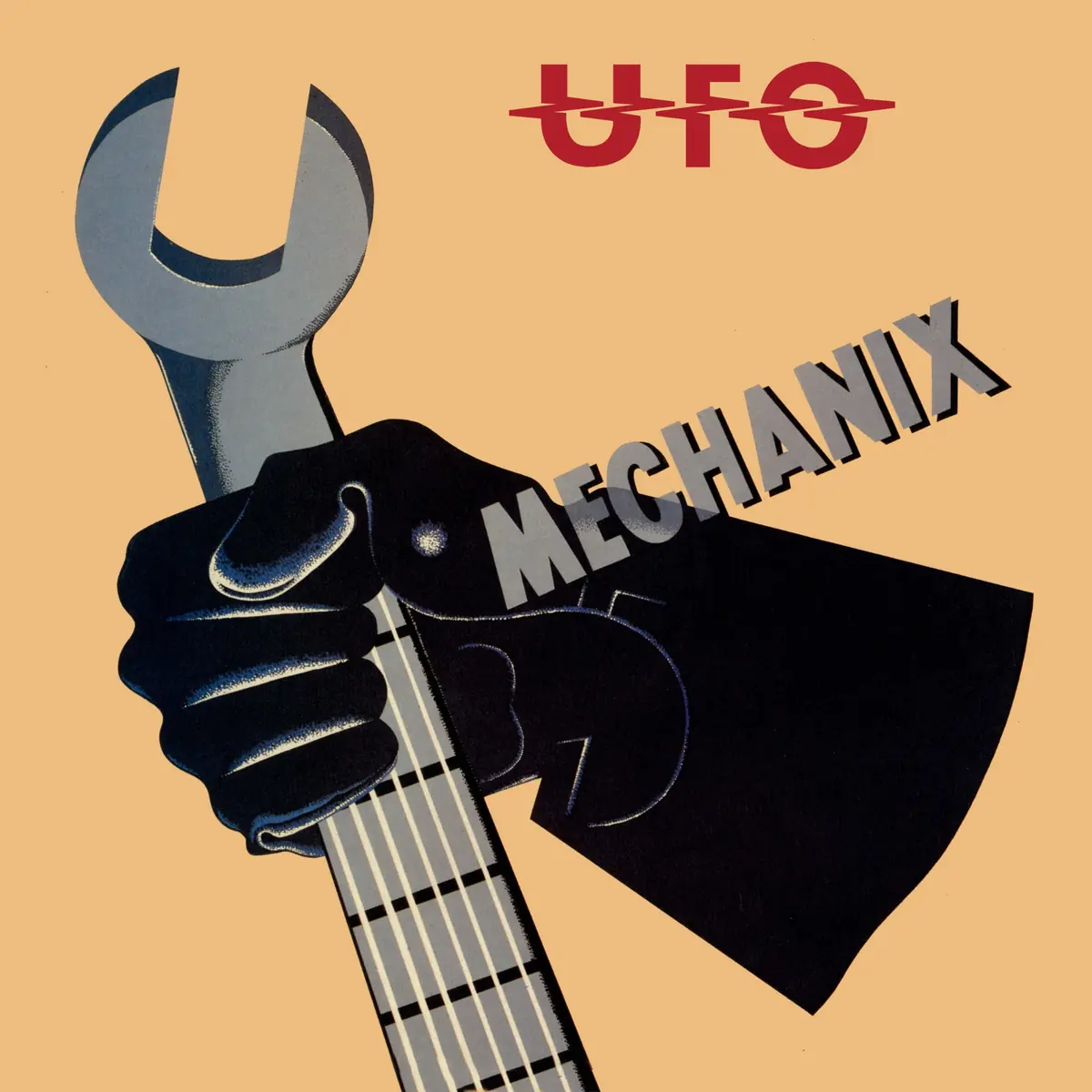
The reason for the call is his latest UFO project, a new mix of the band’s 1982 Hammersmith Odeon show, recorded during the tour for their tenth studio album, Mechanix.
Released under the cheeky tagline Mechanix: It Will Tighten Your Nuts, the album followed The Wild, The Willing And The Innocent, long regarded as one of the finest records in the band’s catalogue. I’ve covered the album elsewhere in conversation with Phil Mogg. Here, the focus is on Brian Kehew’s work with the tapes, the band’s archive, and the enduring magic of UFO on stage.
“I’ve always grown up with the radio on,” Kehew explains as I ask him about his background. “My family were not musicians so much as people who liked music. My mum and dad had a piano, and we all took lessons on piano, guitar and drums when we were young. I didn’t really follow the usual route of joining groups and playing in bands. I stayed at home, read every book I could find and started buying equipment. I was more interested in the technical side: music production, records, and trying to work out what sounded good.
“From there I moved into four-track recording, gradually bought better equipment, and eventually went to recording school in the ’80s to learn it properly. I went freelance, looking for projects, but the interesting twist was that, instead of making new records, I began being asked to work on old ones: Alice Cooper, Black Sabbath. Sabbath were my favourite group, so of course I said yes.
“That became another factor, because I loved analogue even when digital was supposed to be cooler, newer and better. I kept tape machines around, which seemed ridiculous at the time, but people still find me because they have old tapes.
“I didn’t even have a computer in my studio until 2009, when I bought a Pro Tools system for a Black Oak Arkansas reunion record. Since then, it’s become the way to work.”
Brian Kehew started the run of live mixes for UFO with Obsession, followed by No Place To Run and The Wild, The Willing And The Innocent. “Fourth one, I suppose, in sequence. And it’s ongoing, let’s put it that way,” he says, hinting at more to come.
“And we may go backwards as well as forward. I’m not quite sure, but I would love to connect with Chrysalis, which was probably my favourite label growing up. I loved UFO especially, but they had so many amazing acts on Chrysalis. The people that are now at the company get to work with that catalogue, which is really cool.”
Brian Kehew’s route into the UFO project came through James Batsford, the A&R figure now working with the band at Chrysalis. “It’s a little bit complex, but maybe interesting,” he says. “James connected us for all this. I had met him when he was very young. His father was a music friend from England, and they were visiting Los Angeles many years ago. I took them to the Rainbow Bar And Grill, which is a classic rock ‘n’ roll, especially Metal, place.
“Everyone knows it, but I still think it’s the best place to eat around here. I love the environment, and the food is exceptional. We had a very good time. And in the background, my UFO story is that they were the first group I ever saw when I was young.
“That was my first concert. Michael Schenker had gone away, probably permanently by 1979, and Paul Chapman was in. I didn’t care. I just wanted to see UFO. I loved it. It was a phenomenal concert, not knowing anything because I had never seen a show like that before.
“I kept going to see them, and I still love what they do if there’s any option to see them.
“For UFO fans, Strangers In The Night is ground zero. It’s the one. Over time, while working on projects for Black Sabbath, Alice Cooper, Aretha Franklin and Yes, I realised many classic live albums were assembled from different concerts. Yessongs, for example, was built from several 1972 shows, taking the best versions and presenting them as one concert.
“That’s the illusion we all get from records like Frampton Comes Alive! Most bands knew you were unlikely to capture magic on the one night the truck happened to be outside.
“I spent years looking for the Strangers In The Night tapes, knowing there must be more shows recorded. I eventually found them in a Los Angeles vault less than a mile from my home, but I could not touch them because I was nobody at that point.
“For ten years I wrote to management, the band, the label, everybody, saying the complete shows should come out, just as Deep Purple had done with Made In Japan.
“Eventually someone took that idea and ran with it, making a box set of all the Strangers In The Night shows. I bought it, with disappointment, but it was what it was.
“Soon after, James at Chrysalis found out I was a big UFO fan and asked if I would like to work on these projects. It came around to me just after the biggest dream project had passed, but then Obsession came up.
“I suggested remixing one of the shows so it could sound at least as good as the original live album, and we got to do that. It has the flaws any one night will have, but it sounds incredible. I love it. And then we continued with each subsequent record, as we’re doing at the moment.”
We both laugh about that first remix. It is from the Aragon Ballroom in Cleveland and has the immortal phrase that every rock fan now knows. “That’s part of it,” Brian Kehew laughs.” That is the way it opens. They come out and say, ‘Hello, Cleveland,’ about four years before Spinal Tap existed, which is great.”

From an engineer’s point of view, how does mixing a club show like the Marquee compare with a larger venue such as Hammersmith? “One thing we always have to face is that the iconic live record was done by Ron Nevison, who is a producer-engineer. He is one of those unusual people, like Glyn Johns, who was also the engineer getting the drum sounds.
“Having spent years in the studio with UFO, he knew the bass sound, Andy Parker’s tom-toms, everything. So the recordings captured for Strangers In The Night were better than almost everything we have had since. Not exclusively, but mostly.
“It isn’t simply a question of club versus theatre. If a microphone is close to a snare drum, or right up against a Marshall cabinet, the room almost disappears.
“But there are still challenges. In a club, the PA bounces off the walls and affects the drums and vocal spill. In a big room, the spill may be more distant and echoey, and the voice clearer. Each night is different, and each truck engineer is dealing with that night as it happens.
“The Marquee isn’t specifically great or bad sounding, whereas Hammersmith is still a really good-sounding room, pleasant, musical and workable. The bigger thing for me is preserving the character of the show.
“Phil is always funny and charming with an audience. It’s not usual show-business patter. On the original live record, he says, ‘I just got a message. They’re changing the mics. Can I fill in?’ They probably could have cut it, but it shows his informal nature, and it became part of the history.
“So I try to find those moments and leave them in rather than polish everything too much.
“You say the studio recordings, because one of the things I like about UFO, and this is true for their performances, is that they do not vary too far off the map. Later in the day, they would take Doctor Doctor into a long jam and things. They were probably tired of playing it or maybe wanted to stretch a good song longer.
“But if you hear a song, Love To Love or Only You Can Rock Me, it’s like the record. You are going to hear the parts you know and sing along, whereas some bands take it too jazzy or just do not want to play the old songs.
“I think they deliver for the audience very consistently what you do want to hear. Plus, there’s always going to be an element of new material. They were pretty good about bringing out good records with at least two or three strong tracks on every one, and then putting those into the show, which I didn’t mind at all.”

I ask Brian Kehew about the origin of the Hammersmith shows used on The Wild, The Willing And The Innocent and now Mechanix. “It’s unclear, the source,” he says. “I think they must be BBC. And we didn’t have both nights.
“There seems to be some kind of curse on UFO’s career. They should be more popular. Everyone says it, including the band and people like Iron Maiden and Slash. I do not think it is a curse, exactly. It is personalities, timing, record labels, all those things. They could deliver the goods with records, singles and performances. It was all there for them, but it never quite clicked.
“The same thing happens with their tapes. Sometimes we were struggling to find the sources, or a whole show would be missing reels right in the middle. There are a lot of complications, so we do what we can. If it isn’t a complete show from the opening tuning to the final applause, everything we could possibly use is still in there. I would always love it to be longer, but sometimes the tape simply runs out in the middle of Rock Bottom.
“Once in a while, you have to make the smallest repair. On one Rock Bottom, the final chord cut out completely, so I stole the last E chord from another show. That’s not something we commonly do, but otherwise the end of the show was a whimper.
“Then there are recording problems, feedback, monitor issues, things that can nearly ruin a show. Phil says at one point, ‘I’m really upset with the monitor man, and I’m going to throw him at you very soon.’ In the days of analogue tape, that was very hard to fix. Now I can go in surgically and filter out things that would once have made a recording unusable.”
We move on to the differences between the Schenker and Chapman eras. “I actually think Paul Chapman is more consistent,” Brian Kehew says, “and that’s nothing to do with Michael Schenker, who’s still my favourite musician.
“Paul Chapman has a perfect guitar tone always. In those days, pedals and big systems were not common. It was down to your Marshall amp sitting on top of that stack, and Chapman must have had a magic one. Whether it was natural or modified, it always sounded so good. Rhythm or lead, up or down the neck, it sounds perfect, so it’s very easy to work with what he’s doing.
“He always plays so well. Most UFO fans appreciate that the band is a combination of people, so the difference between those guitarists comes down to tone and the parts they play. But the other changes in that period matter too.”

“Paul Raymond was incredibly hard to replace,” Brian Kehew says, “because he played guitar and keyboards, and sang those consistent harmony vocals. Then Neil Carter comes in and adds another dimension, even saxophone now and then.
“The keyboards are really what make UFO different from Aerosmith, Thin Lizzy or early Iron Maiden. They give the songs range, whether it’s Try Me, Profession Of Violence or Love To Love. You don’t always think of UFO that way, but those parts are essential. In this period, with Neil Carter coming in, they don’t really lose anything.
“Having mixed Sabbath, Yes, and all these groups, the only band I have found as tight on stage is ELP. The next best, or almost as good, is UFO.
“When they play together, they are like a machine. When they start Lights Out, it is absolutely locked together on a big stage or a small stage.
“I wonder if part of that is Phil? As a singer, I think he is highly underrated. He should be mentioned alongside someone like Paul Rodgers. Singers who do not scream or show off, but sing the right parts. I prefer that, and it records very well. That clear, thick mid-range always comes through. With a hard rock band, it sounds perfect every time he sings.”

Sadly, Brian Kehew has not yet had the opportunity to chat with Phil, but he tells me of his first meeting with the UFO singer. “We haven’t since I started working,” he says. “But at that very first concert, when I was a lad, we walked around behind the venue afterwards.
“I grew up in San Bernardino, California, which is a bit like Detroit or Birmingham. A tough rock ‘n’ roll town. UFO were big headliners there in the ’70s. Phil came out and sat and talked to us for a while. Years later, around the Misdemeanour tour, I saw him in Los Angeles, and he did the same thing, chatting with everybody out back. He’s just that kind of bloke, accessible and grounded.”
Although this is a job, Brian Kehew is clearly enjoying mixing one of his favourite bands. “In the ’80s Chapman era, I love Diesel In The Dust,” he says. “No Place to Run is often better live than on the record, and Making Moves is a strong, stomping classic rock burner. There are quite a few in there. The records usually had two or three tracks I would call classics.
“Profession Of Violence is one people always talk about, though I do not think they played it live. It is such a different but strong song. And they could certainly write ballads. Try Me is another one that still stands up.
“A mate of mine, who had seen them from ’74 onwards, once said after the split with Michael Schenker, ‘I think Michael needs them more than they need him.’
“Michael made great records, but they were more about guitar solos. UFO had more consistent songwriting, the kind that could have sat on any record from any period. You cannot always tell who wrote what, Paul Raymond, Phil, Pete Way, Chapman or Schenker, and I love that.”
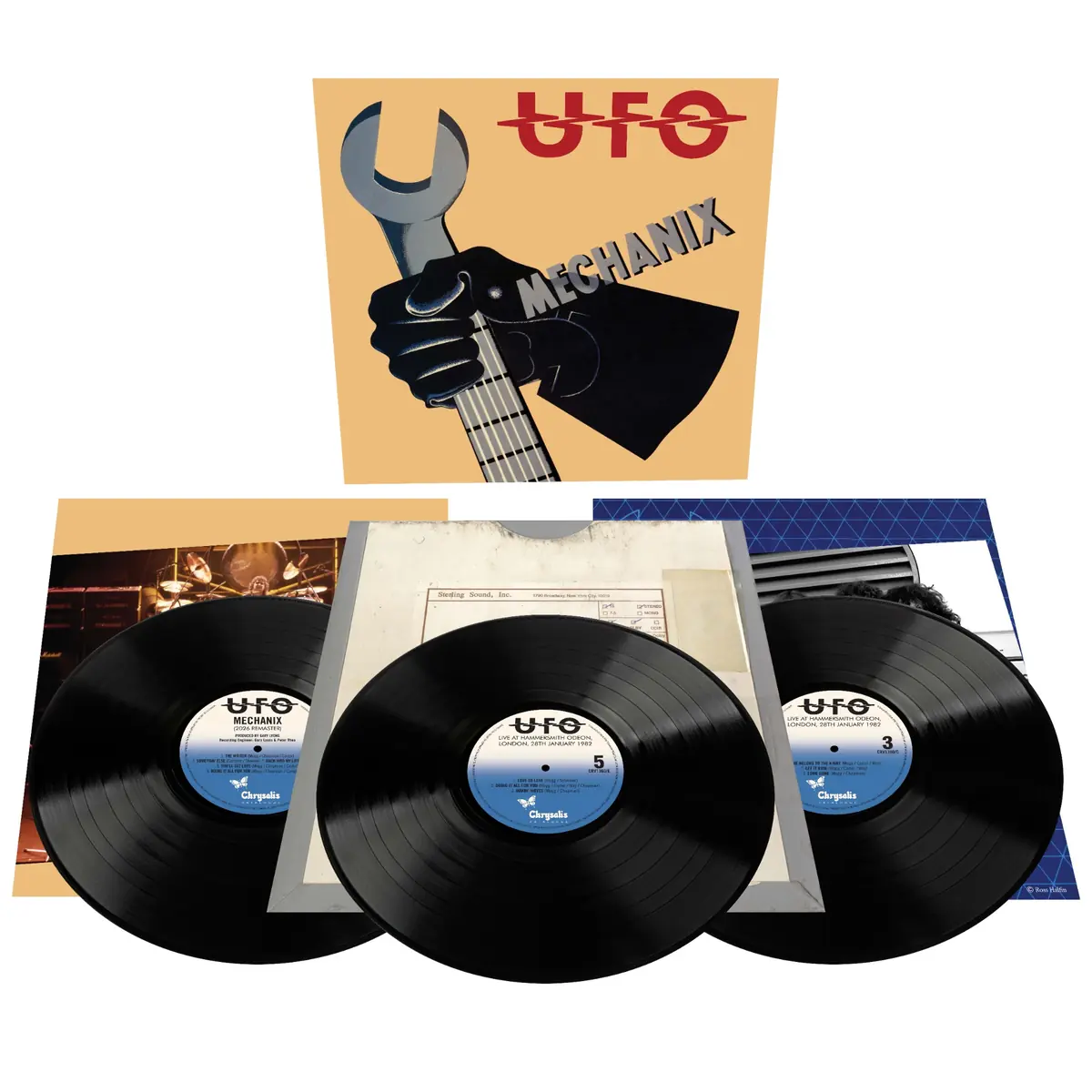
Originally released in 1982, Mechanix marked a pivotal chapter in UFO’s evolution, capturing the band as they transitioned into a new era. This definitive reissue has been newly remastered at AIR Mastering, bringing renewed clarity and punch to the original recordings.
The package is enriched with previously unreleased photographs, offering a visual snapshot of the band during this period. New liner notes by David Hann provide fresh insight into the album’s creation and legacy, drawing on exclusive interviews with key band members, including Phil Mogg, Andy Parker, and Neil Carter.
A major highlight of this edition is the inclusion of a newly mixed live recording from Hammersmith Odeon on 28 January 1982, restored by renowned producer Brian Kehew.
Capturing UFO onstage at London’s legendary Hammersmith Odeon, this performance showcases the band’s raw energy and musical firepower on the eve of the release of Mechanix.
This expanded edition of Mechanix stands as both a historical document and a compelling reminder of UFO’s enduring place in hard rock history. Released on 4 December 2026 via Chrysalis, pre-orders are available from ufo.lnk.to/MCHX.
You can read our interview with Phil Mogg about Mechanix here. You can read more on UFO at MetalTalk here.